Calligraphy Student Spotlight: Neus Sáez
This is a new section on my Writing Calligraphy educational website where I interview professional calligraphers who make a living primarily from their work, as well as calligraphy students at different stages of their learning journey, as I’m very interested in both points of view.
I’m kicking off this Calligraphy Student Spotlight with a dear student of mine, Neus Sáez, whose passion for calligraphy, future goals and respect for this art form are evident in the answers below.
Reach out if you would like to be featured!
Photo credit above: Calligraphy sketchbook by Neus Sáez.
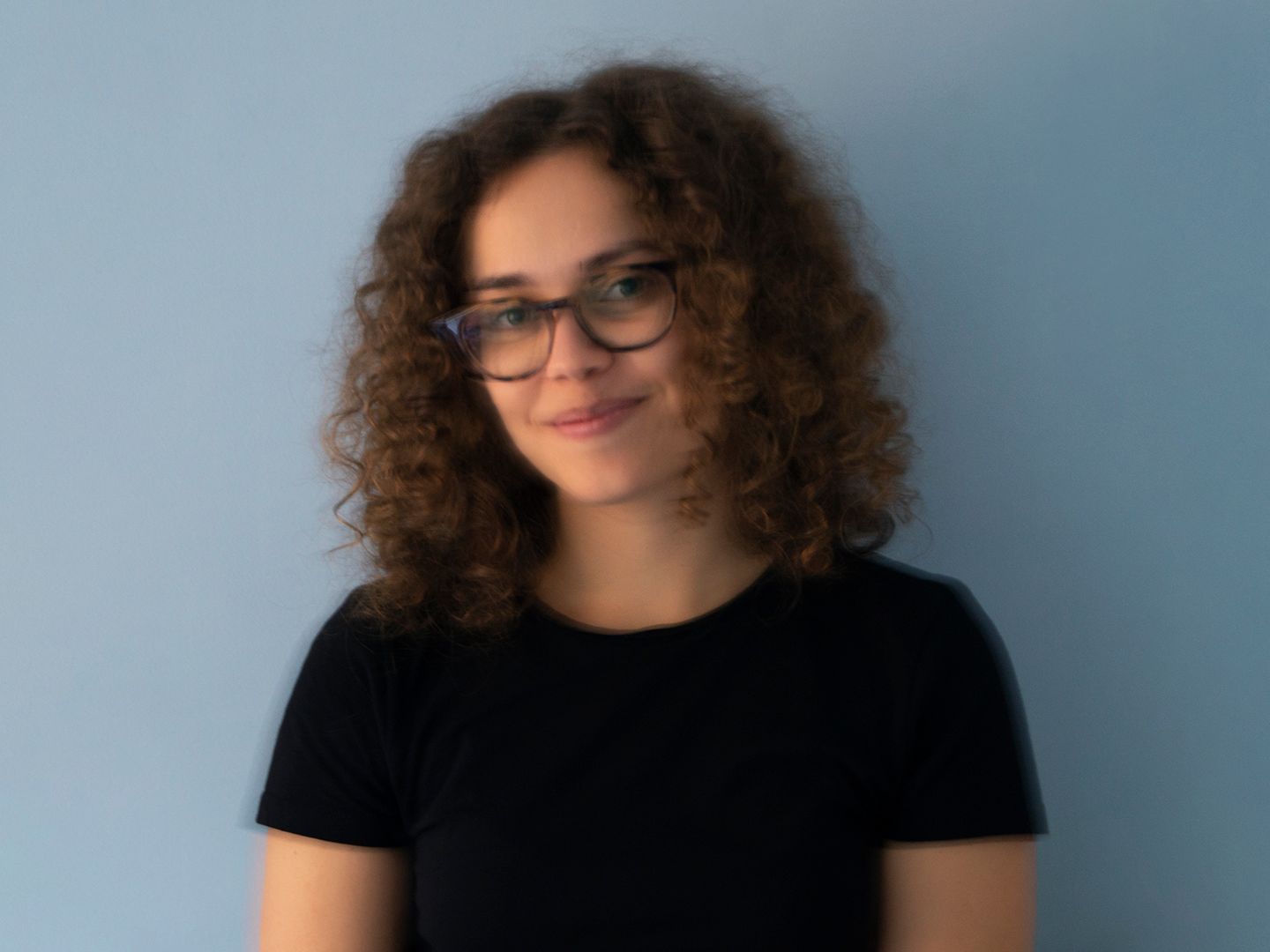
Profile photo: Neus Sáez
1. CALLIGRAPHY STUDENT PROFILE
What is your name, age, current occupation and location?
Neus, 27, Graphic designer, Barcelona.
How long have you been practicing calligraphy?
More than 2 years.
How did you first discover calligraphy, and what drew you to it initially?
I remember being a child and looking at my grandfather's handwriting and marvelling at how he wrote the most beautiful letters using the same pen as everybody else.
When I grew up and became interested in typography and lettering, I learned that calligraphy was at the root of every drawn letter. I wanted to understand how to apply its guiding principles to my drawing practice, and also marvelled at how a letter or a word could look so... "finished" (it's how I would have described it at the time) after just being written with a tool.
Do you consider yourself a beginner, intermediate or advanced calligraphy student?
Intermediate student.
Have you taken any in-person or online courses? If so, do you have a preference?
I have taken both but prefer in-person courses– I'm lucky enough to live somewhere with access to them. I feel like they give more room for discovery and spontaneity, as you are usually in a room with other people who are learning at the same time; unplanned things happen when learning among others. Also, when you're a beginner, I believe in-person classes can make it easier for the teacher to correct things like posture, grip or problems with materials.
Who or what has had the greatest influence on your development as a calligraphy student?
Undoubtedly, my teachers:
Oriol Miró,
Ivan Castro,
Laia Soler,
Maria Montes... The way I've learned calligraphy goes beyond basic and quick instructions to get beautiful results. I think their teachings carry a lot of respect for the practice, its history, and the calligraphers who came before them: setting solid and careful foundations before also giving the freedom to experiment with expressiveness and tools. What I learned from them goes far beyond what I could have ever learned on my own, and I'm very grateful.
Do you have any recommendation for students wanting to start their calligraphy journey?
From a more tactical standpoint, I would recommend them to find classes with experienced teachers and get involved with others who are also interested in calligraphy, if possible. I believe looking at other people's work is very enriching. But my more heartfelt, individual advice would be to find texts (poems, extracts from novels, lyrics from songs...) that they would like to spend time with, any words that resonate with them, and get excited about making projects with them once they've learned how to write in any script. Create your own collection of texts, don't forget to sketch to try out different compositions and enjoy making personal projects.
Which calligraphy scripts or styles do you feel most connected to, and why?
I would say Roman Capitals, Italics, and the Neuland style.
I love how Roman Capitals look very classic but can also be very expressive. I find them very relaxing and rewarding to write with a brush on cotton-based fabrics, since a lot of beautiful textures come up organically.
Italics make me feel very connected to the text I'm writing, since it's easy to flow with them, and writing with Neuland is always just a good time. :)
Is your calligraphy practice 100% analogue? Do you use Procreate or vector-based software at all?
I only use vector-based software if a project requires it; for instance, if a client wants a logotype that is calligraphy-based. In my own practice, I'm fond of the tactility of materials and the happy accidents that occur when going analogue.
Do you see calligraphy more as a hobby, a future job, a possible career or a vocation—or a combination?
A combination of a vocation and a career. Working on calligraphy projects feels very rewarding to me, and I would love to spend more of my time doing it. I like to picture myself in the future combining calligraphy work with lettering and typography projects, which I also love.
Have you done any client work? If so, how did you find the experience? Would you like to do it again? If not, would you like to do it at all?
I have worked as a calligrapher in live events and also regularly work on the handwritten numbering of limited editions of books. I would love to do both again and anything else that comes up.
Live events are very fulfilling, because people are very warm about the things I write for them– names, messages for their loved ones... And the numbering of limited editions makes the books feel truly special. It's gratifying to think about the people that will receive the things you write, and how the handwritten element will add emotion to the final product.

Photo: Glass calligraphy engraving by Neus Sáez
2. Consolidating Fundamentals
Which foundational calligraphy skill do you feel most confident in now, and which still needs reinforcement?
Something I really needed to interiorise was giving myself time and grace to learn new scripts in an unrushed way and without judgement. Looking at manuscripts and working slowly, paying attention to the angles of the strokes and the contrast of the letters, understanding that slow and steady wins the race. I have learned that this kind of patience and understanding the learning process as accumulative helps me feel more confident when working, especially on projects for clients.
On the other hand, I think I still need to be more consistent about working without any kind of guidelines. I know it will help me to better assimilate the proportions of each script, but some days it's hard to be comfortable with the mistakes that come as part of that process– you want your letters to look as good as possible. It's necessary, nonetheless.
What technical habit has been hardest to unlearn as you progressed?
Sometimes, I felt too comfortable with the grip of my pen at a certain angle, and that made the thickness and contrast of some scripts feel a bit off. Stopping more frequently to look at my work and paying more attention has helped me get better at it.
How has your understanding of basic letter structure changed since you began?
It felt really important to learn how different scripts are connected through history and form, for instance, how a capital 'A' goes from being that way to a minuscule 'a' and how its shape is a response to its moment in time. Another thing was the importance of the ductus, understanding why the order of the strokes is not arbitrary, and why it's important to respect it.
What recently “clicked” for you in your practice?
I have been aware of this since I started to learn calligraphy, but the importance of breathing while writing is something that is on my mind a lot lately. How the breath is an extension of your state of mind but also impacts your body, and in doing so, your arm and hand movement while writing. I think part of why calligraphy can feel a bit like a spiritual practice sometimes is because when mind, body, and breath are aligned and you feel connected to your project and its content, you can feel a sense of peace and serenity.
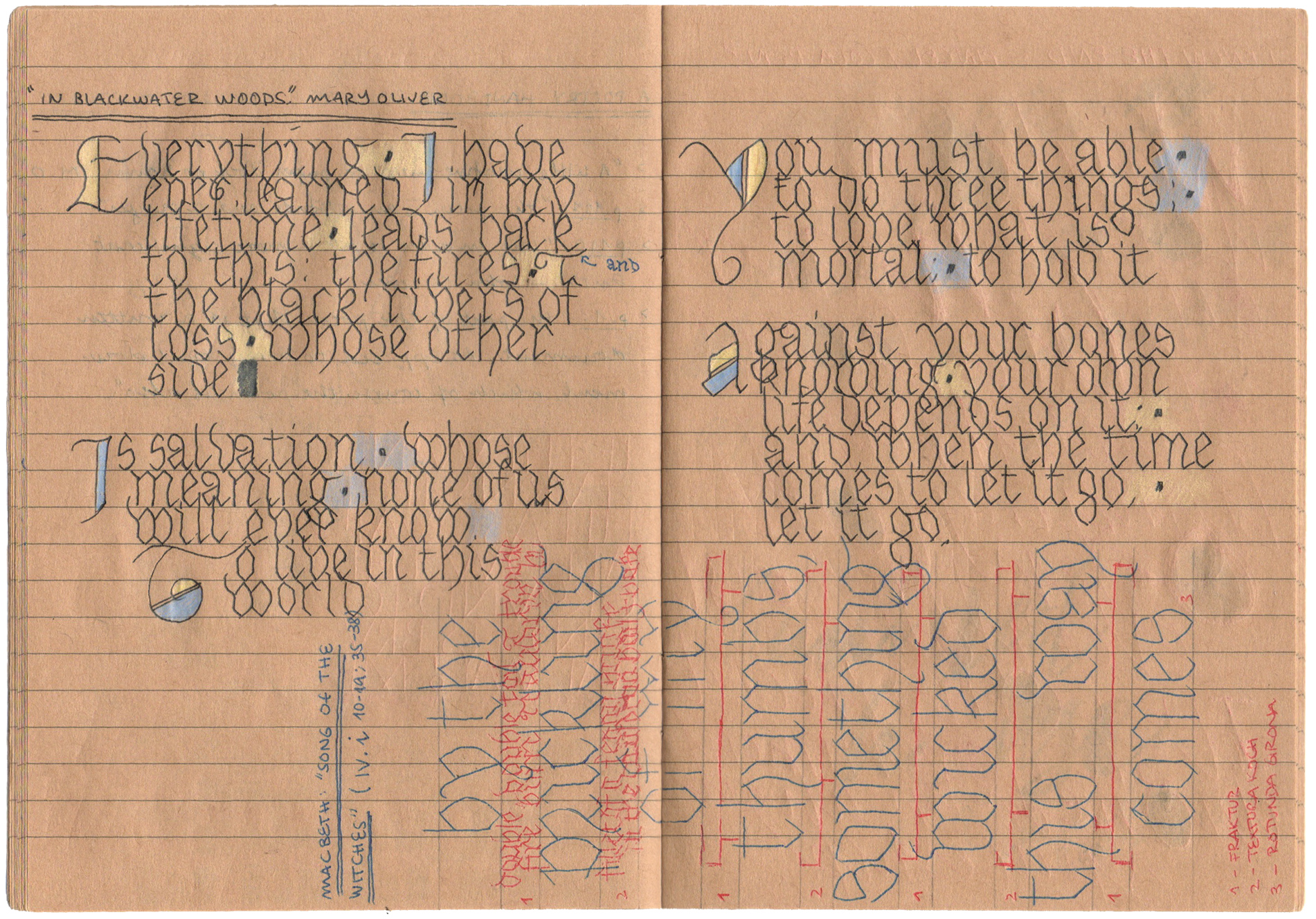
Photo: Sketchbook by Neus Sáez
3. PRACTICE & CONSISTENCY
How do you currently structure your practice sessions?
One of my main goals this year is to build a more consistent and frequent practice routine, and I'm still figuring out what works best for me. As of right now, I think that looks like spending several sessions with the script I'm practicing at that moment, trying out how it looks in different sizes with different nibs, before moving on to the next one. I intend to carve out blocks of time in my week so I can have quality time to practice and hopefully end the year with a bunch of filled sketchbooks.
What helps you stay consistent when progress feels slow or uneven?
Looking at other people's work and asking myself what moves me or inspires me about it, and being really specific about the answer. It varies from day to day: it can be expressiveness, their use of composition or materials… It's about finding that exciting element and chasing that spark in my work.
Something that has also helped sometimes is changing the medium I work on: since last year I've been trying my hand at engraving glass, and I really love it. It motivates me and makes for great gifts.
How do you decide what to focus on when you sit down to practice calligraphy?
Sometimes I already have a text or phrase on my mind I want to work on, and I choose a certain script based on the look I believe it should have and the emotion it evokes.
Other times, I miss practicing a certain script or feel like it needs some “refreshing” in my mind, and then spend some time with it.
What kinds of exercises have been most helpful at this stage?
Copying pages from manuscripts and trying to get as close as possible is something I learned from my teachers at the
Barcelona Caligrafia School and I find it really helps when trying to perfect your script. It makes you slow down when writing, really stop to think about how the letter must have been written to achieve that certain look, and then wonder if it's the same way you would write it at that stage or if you have to make any adjustment. It requires time, and if I'm short on it but want to make sure I'm practicing all the letters of the alphabet, I stick to writing pangrams or a list of names (from people I know, music bands, fictional characters…).
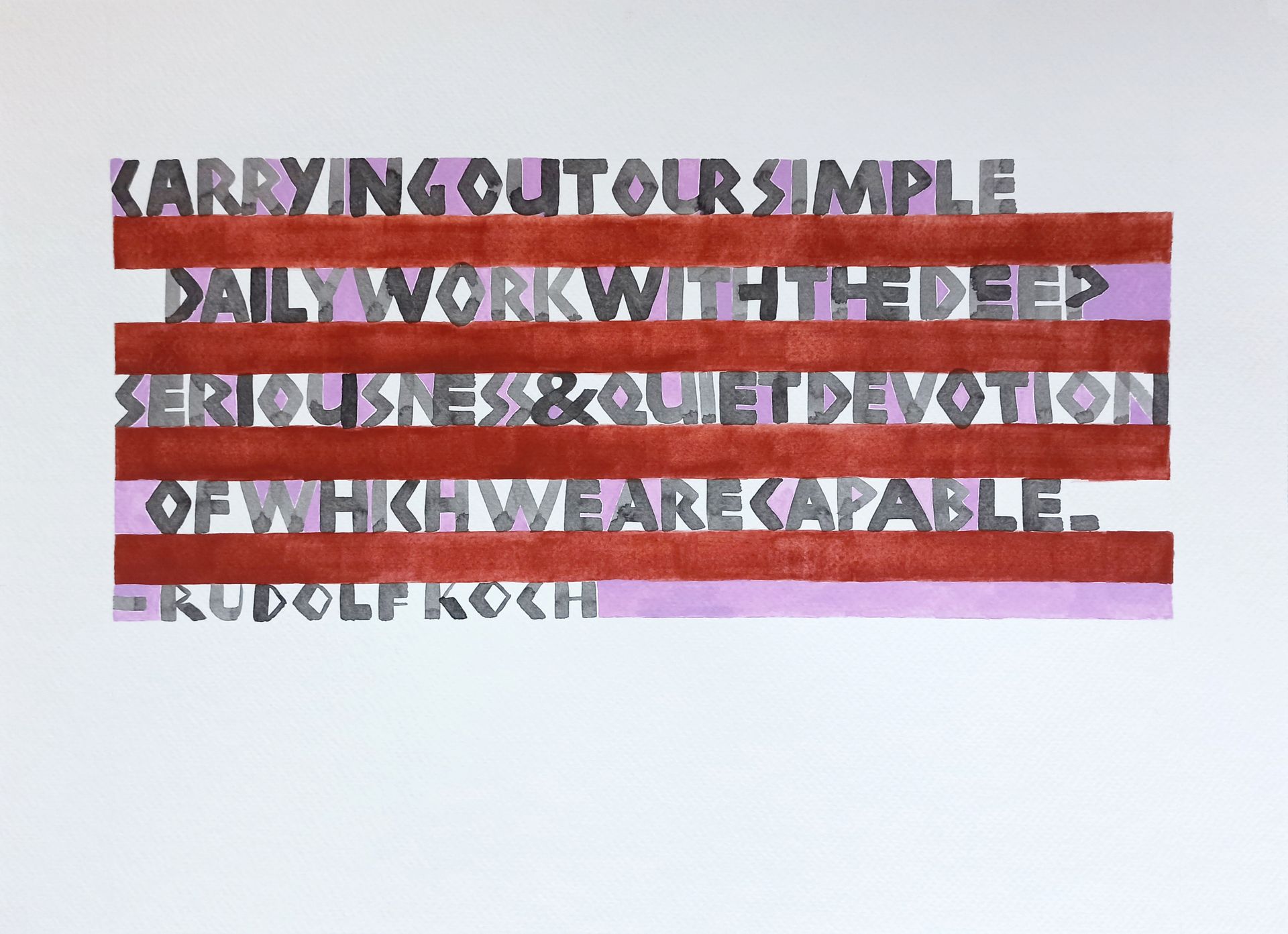
Photo: Neuland calligraphy by Neus Sáez
4. LEARNING & OBSERVATION
How has your ability to see and analyse letterforms improved over time?
I studied typography before I learned calligraphy and I believe having a background in both has been really useful when analysing letterforms. Elements like contrast, proportions and thickness are the building blocks of creating letters, and spending time with scripts and building an intuition when it comes to thinking about those elements is very useful to understanding how (and why) they work, especially when looking at others' work.
What common mistakes do you now recognise in your own work that you didn’t notice before?
I see a lot of spacing errors in my first projects and practice sheets! I believe it takes some time to interiorise how the negative space works and how much space you should leave when writing the next letter in a word.
How do calligraphy exemplars or model alphabets support your learning right now?
I believe they're very useful, and I like to keep close all the models I've gathered throughout the courses I've taken when practicing. Firstly, in case I need to make sure the ductus of a certain letter is correct, and secondly, because sometimes looking at other people's models can make you think about their way of doing things and your own: I remember that, after taking Copperplate courses with two different teachers, I compared their models and realised each one had their own way of approaching the script, even if the base of the letters was the same.
What role does repetition play in your calligraphy improvement at this stage?
I think repetition always plays an important role when learning calligraphy, because even though conscious practice is essential, it's also important to build muscle memory to be able to work more intuitively, and the only way of doing that is practicing and practicing. Repetition helps me integrate the right way of doing things so I can later experiment while being aware of the changes I'm choosing to make.
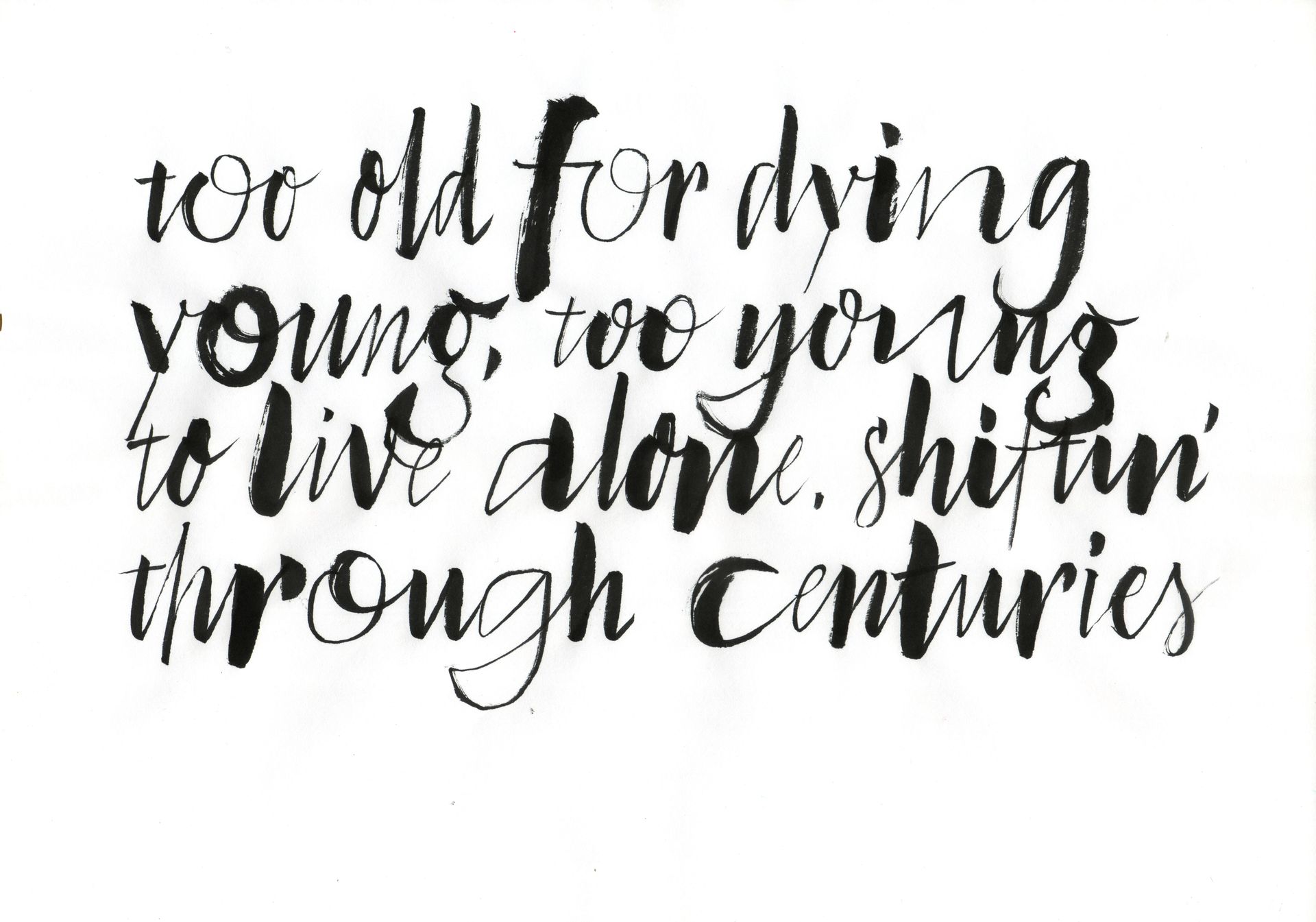
Photo: Expressive Italic calligraphy by Neus Sáez
5. Developing Confidence & Voice
When do you feel most confident in your writing, and when does doubt appear?
Doubt always comes tangled with outside perception for me. For instance, I was given a weekly diary for my birthday and each week comes with a lined page for writing notes. I've gotten into the habit of writing poems and songs as a way to summarise the week and I do it trying out different scripts, only writing the skeleton of the letters with an ordinary pen. Since it's just for me and I know I won't show it to anyone, it's when I feel most free writing. Sketching is also a moment I really enjoy and when I feel really at ease working.
It's when I'm doing something that I know I show to others that I start second-guessing whether it's good enough. Nonetheless, at the end of the day, I also know that self-doubt can be my biggest enemy, since it can become paralysing– I know I have to push through, knowing done is better than perfect and that to get closer to the results I want I need to keep going at it.
Some other times I just need to step away from my work and look at it with fresh eyes to be more objective about it.
Are there early signs of personal preference or style emerging in your calligraphy work?
Lately, I'm noticing I really enjoy working with a flowing baseline– waves, twirls… It adds an element of difficulty because of the spacing issues that may occur if the curves are tight, but I find I really like the results. I also like combining different sizes and scripts.
How do you balance following rules with experimenting a little?
I find both are important. Sometimes it depends on the text I'm working on and what I feel it demands, other times it's more about how I'm feeling at the moment and whether I feel a bit stuck in my practice.
What kind of calligraphy work feels just outside your comfort zone right now?
I would be intimidated by work involving drawing or painting beyond just doing really basic things, since it's not my area of expertise. It's something I would like to get better at and offer, but at the moment it would feel really outside of my comfort zone.
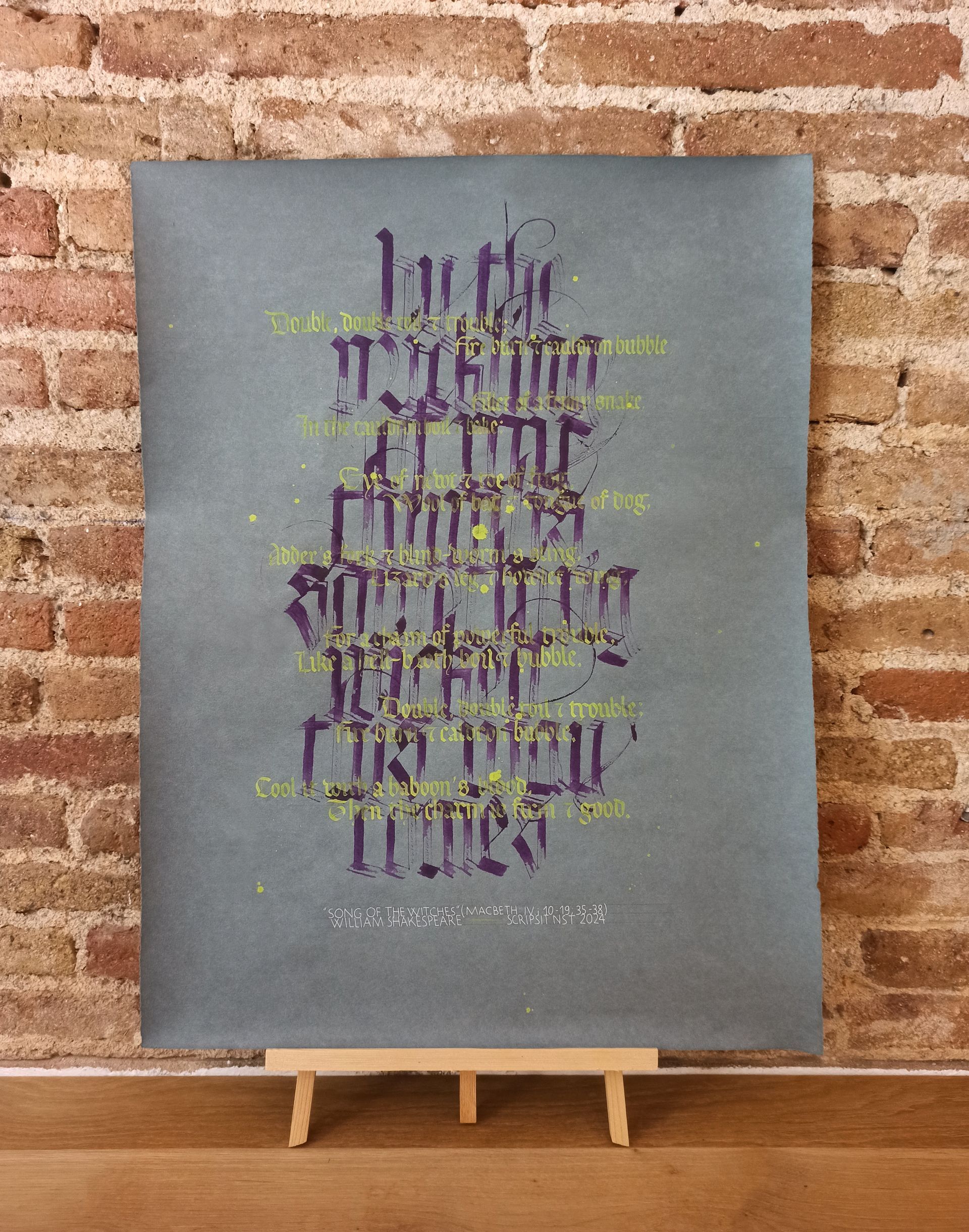
Photo: Gothic/Blackletter calligraphy by Neus Sáez
6. FEEDBACK & COMMUNITY
How has receiving feedback influenced the way you practice calligraphy?
The feedback I received as a student, specially the comments I got more than once, is something that I still keep in mind when practicing– for example, the angle of my strokes feeling a bit off that I was telling you about earlier. I also think a lot about what our teachers repeatedly tell us: "relax your grip and let the pen flow".
What type of feedback do you find most useful at this stage of learning?
Any kind of constructive feedback is helpful, but I really enjoy when people I've studied with (both teachers and fellow students) tell me what they think about my work and how I could take it further. I believe that receiving feedback from your community helps you grow faster.
Do you share your calligraphy work on social media?
Up until now, I've mostly shared things on Instagram Stories, since putting things on my feed felt more permanent and carried those feelings of self-doubt and anxiety I was talking about earlier. However, since I'm now more focused on getting more calligraphy projects to make it my future job, I'm working on getting better at sharing my work and posting more past and current projects to be able to better show what I'm able to do to potential clients.
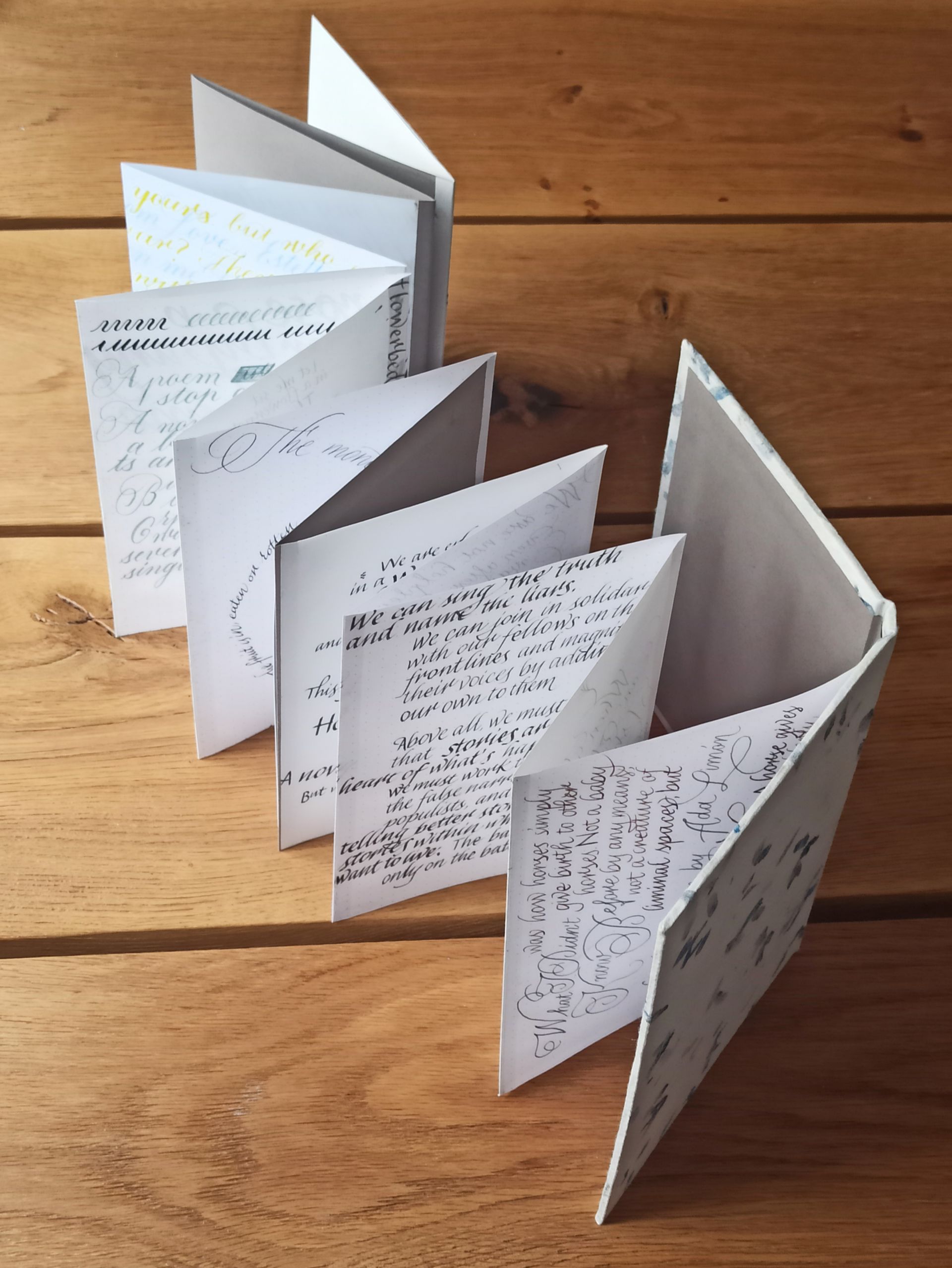
Photo: Sketchbook by Neus Sáez
7. LOOKING ahead
What are your next goals in your calligraphy journey?
I want to be able to work in calligraphy full-time, so right now my main goal is to get more commissions and calligraphy projects. I know that in order to do that, getting better at sharing my work is the next step, so I am working on that while also enjoying my personal practice.
Where can people find your work online?” (website / socials)
As of right now, my Instagram profile: @nesu.otf
Stay tuned for a lot more posting in the future :)